The French Traveler

Guided Tours of France - Immersion Tours

  • Home
  • Paris Tours
    • Best of Paris tour
    • Best of Paris Registration
    • Holiday Magic in Paris
    • Holiday Magic in Paris Registration
  • Teachers: Eté 2026
    • Bonjour Chers Collegues
    • Eté 2026: Nantes Tour Schedule
    • Immersion Workshop Cost & Details Nantes 2026
    • Video: Immersion Tours for Teachers of French
    • Teacher Immersion Registration
  • Wine Tours
    • Sip and Savoir: A Wine Trip to Burgundy
    • Sip and Savoir Registration
  • About
  • Contact
  • Fbook

The upcoming French presidential election

December 26, 2012 by Valerie Sutter, Director, The French Traveler Leave a Comment

Elections présidentielles

It’s election time in France with the upcoming elections known as Les Presidentielles. The French vote for their president in two rounds, spaced two weeks apart, the first round of which will be held on Sunday April 22, 2012. If there is no decisive winner (50% + 1) on the first round, the run-off between the top two polling candidates will be held on Sunday, May 6, 2012. In order to be a legitimate candidate, a person must first obtain the signatures of 500 elected representatives; ten candidates qualified in 2012.

Here, appearing in alphabetical order are the ten candidates for Président (or Présidente) de la République française 2012, their political party affiliation, and the slogan of their campaign. Drumroll…..

• Nathalie Arthaud, 42 years old, from the political party Lutte Ouvrière (Workers’ Struggle). Slogan: “Une candidate communiste.”

• François Bayrou, 60 years old, from the Mouvement Démocrate party. Slogan: “Un pays uni, rien ne lui résiste” (Nothing Resists A United Country).

• Jacques Cheminade, 71, from the party called Solidarité et progrès (Solidarity and Progress). Slogan : « Le sursaut » (The Jump).

• Nicolas Dupont-Aignan, 51, from the party Debout la République (Republic, Rise up) with the slogan: “Pour une France libre” (For a Free France).

• François Hollande, 57, Socialist party, slogan: “Le changement, c’est maintenant” (Change is Now).

• Eva Joly, 68, from the environmental party known as Europe Ecologie, with slogan « Le vote juste » (The Just Vote).

• Marine Le Pen, 43, from the Front National (National Front party), with the slogan: “La voix du peuple, l’esprit de la France.” (The Voice of the People, The Spirit of France).

• Jean-Luc Mélanchon, 60, from the Parti de Gauche (The Party of the Left). Slogan: “Prenez le pouvoir” (Take Power).

• Philippe Poutou, 45, from the party called: Nouveau parti anticapitaliste (New Anti-Capitalist party). Slogan: “Aux capitalistes de payer leur crise” (Let the Capitalists Pay for Their Crisis).

• Nicolas Sarkozy, 57, from the Union pour un movement populaire (Union for a popular movement). Slogan: “La France forte” (Strong France).

This is a closely watched french presidential election, and polls vary wildly as to the winner, which currently suggest either François Holland or Nicholas Sarkozy in the second round. Whoever wins will preside over the republic for a five-year term. Vive la République !
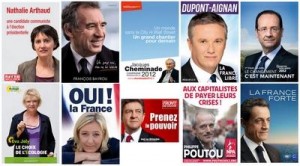
french presidential election candidates

Source: Website Franc-parler http://www.francparler.org/parcours/politique_election.htm
Filed Under: French customs & culture

The beautiful Dordogne Valley, France

December 26, 2012 by Valerie Sutter, Director, The French Traveler Leave a Comment

Named for its majestic river and beautiful valley, the department of Dordogne in south west France is one of the five departments making up the region of Aquitaine. Endowed with a soft, gentle beauty (in contrast to the dramatic extremes of Provence, for example), this region is rich with history, scenic landscapes and charming villages, and is one of France’s favorite vacation destinations. Not only a land of mystical troubadours, but one of reasonable thinkers, the area has produced such statesmen and writers as Montaigne, Fénelon, La Boétie and Montesquieu. Other interesting finds in the Dordogne:

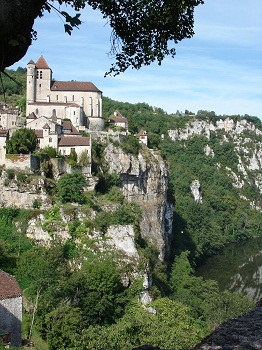
  • St Cirq surplomb la riviere in DordogneCastles – over a thousand of them, more than any other region in France — are scattered throughout the area: Castelnaud, Montbazillac, Hautefort, Eyrignac….Many of them receive visitors, some cultivate wine, and some even have bed-and-breakfast capabilities. You’ll think you’ve entered a fairy tale!
  • Historical towns such as medieval Sarlat, Nontron and Bournat boast beautiful medieval architecture, pedestrian streets, scenic views and specialty shops. On the scenic Vézère river lies Saint Léon-sur-Vézère, which has been classified as one of the “most beautiful villages of France.” And St-Cirq Lapopie and Rocamadour, perched atop impossible cliffs, are simply breathtaking.
  • Prehistoric sites, especially in the Vézère valley, dominate the region. You’ll find the famous Lascaux cave paintings as well as other caves, troglodyte dwellings and prehistoric sculptures. Beautifully preserved and tourist-friendly, these sites make you feel like you’re in a time machine going back centuries, providing a great appreciation for our fellow mankind of yesteryear.
  • Delicious regional cuisine, combined with excellent wine, helps to clear your thinking: enjoy truffles, fois gras, duck, garlic soup, and sweet white Bergerac wines as you glide down the Dordogne River on one of the charming gabares which motor indulgently along the river.
  • Festivals are celebrated all summer long in each of the towns in the Dordogne. Likely honoring a patron saint, the town dresses itself up, hosts a parade, wine tasting, communal picnicking, a bal musette (accordion songs to which the locals dance), and good general animation. Great fun to attend and watch.

Want to practice your French while touring this beautiful area? French teachers and other francophones are welcome to join our Extension Tour to the Dordogne July 26-29, 2012 to immerse themselves in the language and culture of this region, while enjoying the subtle beauty and excellent cuisine of the Dordogne. Click here for details.

Filed Under: French towns & villages, Towns & villages

The Revolt against Fast Food in France

December 26, 2012 by Valerie Sutter, Director, The French Traveler Leave a Comment

When American-style fast food began to “invade” France in the late 1970s, it was deemed to be a passing fad, not able to catch on to sacrosanct traditions of leisurely French dining. How could a 20-minute hamburger & coke possibly supplant a 2-hour, 3-course lunch? Fast-forward thirty years: fast food has not gone away. It has proliferated. Surprisingly, even the French have changed and embraced sloppy food habits, falling victim in the process to some of the same ills Americans have once food becomes available 24/7.

fast food in France

The French press has written extensively about the rise of obesity amongst the usually-trim French, and has long railed that the strong French tradition of family dining and convivial meals has gradually dissipated in the face of “la malbouffe” (junk food). French fast food seems to be gaining popularity still. The stories in the press point to an increasing lack of food awareness in a nation that prides itself on its culinary traditions. The most recent and serious attack has come from Xavier Denamur, a disenchanted French chef, owner of a classic brasserie in the trendy Marais district, who saw the lowering of the 19.6% sales tax on food to a mere 5.5% as a political move by then-president Nicolas Sarkozy to salvage votes from the extreme right. The result, Denamur felt, was a devaluing of the relatively high standards of food production in France. To make his point, Denamur teamed up with director Jacques Goldstein to produce a forceful documentary against the widespread harm of junk food; “La République de la Malbouffe” is roiling the French food establishment. Watch the trailer HERE:

MacDo anyone?

Filed Under: French customs & culture, French food

French Christmas: Noel in France

December 7, 2012 by Valerie Sutter, Director, The French Traveler 38 Comments

French Christmas: Noel in France

Now that Christmas is finally upon us, do you know about these Christmas traditions in France?

  • In some regions of France the Christmas season starts on December 6th, St. Nicholas Day, and is celebrated by exchanging gifts in memory of the historical 4th century saint renowned for his generosity.
  • Most French people celebrate Christmas on December 24th with a huge meal eaten after midnight mass called le réveillon, which may include: goose, turkey, chestnuts, paté de foie gras (goose liver pâté), boudin rouge (blood sausage), or boudin blanc, oysters, and of course for dessert the bûche de Noël, a rich, creamy sponge-like cake in the shape of a Yule log.
  • Tradition has it that on Christmas Eve in France, children would leave their shoes out (not stockings!) in front of the fireplace for le Père Noël to fill with treats and toys. In some regions, especially eastern France, le Père Fouettard (the “Whipping Father”) would come if children had been naughty, not nice.
  • In the south of France, people in the countryside may leave a Yule log burning in their fireplaces during the Christmas season to ensure a good harvest.
  • In Provence, the traditional meal ends with a parade of les treize desserts—the 13 desserts!
  • Most people in France do not decorate the outside of their homes; municipalities, on the other hand, adorn the public spaces with holiday lights and organize reenactments of the nativity story in town squares.
  • French families may set out a crèche, or nativity scene; in the south of France this includes santons (little saints) which are clay figurines depicting not only the holy family, shepherds and wise men, but the townspeople as well.
  • Christmas markets are another holiday tradition in France, especially in the Alsace region, where you can buy all sorts of special foods as well as arts and crafts typical for the season.
  • At Christmastime you will hear traditional carols, both religious and non-religious, such as: Il est né le divin enfant, Un flambleau Jeannette Isabelle, Vive le vent (Jingle Bells) and Mon beau sapin (Oh Christmas Tree). They even have a version of Rudolf the Red-Nosed Reindeer (Le petit renne au nez rouge…). And of course Petit papa noël sung by Tino Rossi is a Christmas favorite.
  • The Christmas season ends in early January with the feast of the Epiphany and the Fête des Rois (Feast of the Magi).

Joyeuses fêtes à tous!

Filed Under: French customs & culture, seasons

Avignon, la sonneuse de joie

September 29, 2012 by Valerie Sutter, Director, The French Traveler Leave a Comment

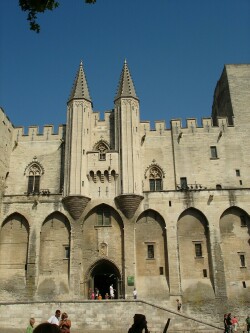
Popes' Palace, Avignon FranceThinking of visiting Provence? Then mark your maps for a stopover in Avignon. Located in the south of France in the department of the Vauclause, Avignon is a beautiful city surrounded by medieval ramparts in the heart of Provence. During the fourteenth century, it became the residence of the Popes. As a result of the Great Schism—the great division between the Roman Catholic Church and the Eastern Orthodox Church—the Roman Church re-established itself in Avignon, and to recognize this fact, Le Palais des Papes was constructed in 1335, under Pope Benedict XII and his successor, Pope Clement VI. Now recognized as a UNESCO world heritage site, it holds 15,000 square meters of living space, making it the largest Gothic palace in the world.

A visit to the Palais is a must. The magnificence of yesteryear is felt throughout the entire palace, although today empty, but the guides revive history in the empty rooms and recount the lustrous meals, the costly guards, and the elegance of the papal reign. The cost of admission: 10.50€, reduced: 8.50€. Tours and cultural events are offered throughout the year.

The city of Avignon is surrounded by ramparts, built since 1355 to protect and fortify the city from mercenary assaults. There is no cost to see them. They provide a beautiful view of the city, and add to its intoxicating medieval charm.

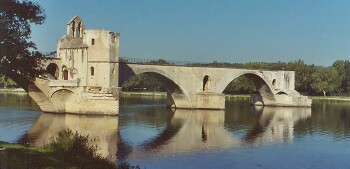
Another UNESCO world heritage site found in Avignon is the famous Pont d’Avignon, also known as the Saint Bénezet Bridge which Le Pont d'Avignonoverlooks the Rhone River. Built in the twelfth century, it collapsed several times due to the flooding of the river. The bridge underwent several reconstructions, but a flood in the 17th century finally put the bridge out of commission. Now only a few of the bridge’s arches remain today. The famous children’s song “Sur le Pont d’Avignon” references this bridge, providing its listeners with the historical and cultural significance, since the Middle Ages. To visit the Pont d’Avignon, it costs 3.50€ as a reduced admission, 4.50€ for a regular admission.

Amongst the other landmarks to see in Avignon is the beautiful Cathédrale Notre Dame des Doms, constructed in 1037. Since then, the cathedral has undergone much reconstruction and expansion, the last of which took place near the end of the 17th century. Admission is free to the general public. The Musée Calvet (the museum of art and archeology) and the Musée Angladon (more contemporary art, impressionist art) are also well worth seeing.

Host to one of the most innovative and successful theatre festivals in the world every summer in the month of July), Avignon has much to offer to its visitors. Its charm, history, culture, mild climate, and welcoming people make this city a must-see while traveling in France.


Filed Under: French towns & villages, Towns & villages

Lille: A refreshing surprise in the north of France

September 21, 2012 by Valerie Sutter, Director, The French Traveler Leave a Comment

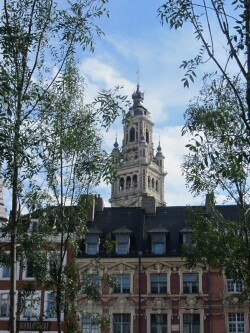
Beautiful Flemish architecture Lille

La Grand’Place Lille

Expecting a drab, chilly northern city on my first trip to Lille this summer, I was delighted instead to find a colorful metropolis filled with lively, cheerful people and more cultural activities than many French cities to the south. I was bowled over by the friendliness of the waiters in the restaurants, the staff at the hotel at which I stayed, the people on the bus, the curators at the museums I visited, the beauty of the architecture. There’s an overwhelming exuberance in this city that permeates all activities and fills the visitor with a pleasant sense of acceptance. Quelle surprise!

Take, for example, the Vieille Bourse, a seventeenth-century building in the heart of town. Beautifully sculpted and colorfully decorated, this former commercial exchange built in 1653 is actually composed several small houses constructed around a central open patio originally designed to afford a calm and protected area for the financiers to conduct business away from the elements. Modernized today with shops and restaurants, it was the scene one Sunday afternoon in August of a vast collection of books and art. Couples wandering the interior patio leisurely browsed the stalls and thumbed through the various books, some rare collections, some posters, old engravings and more….a bibliophile’s dream. The very same patio later on that evening had turned into a Milonga: tango lovers, both amateurs and experienced, dressed accordingly in elegant outfits and high heels,danced under the stars to the cherished tango music of the DJ, who blasted out old favorites of Carlos Gardel and Alberto Castillo from his station in the corner.

After decades of slow and painful decline from the destruction wrought in the area by two world wars, Lille has made a comeback in recent years, thanks to an urban remodeling project called Eurolille that began in 1991. The Euralille Centre was opened in 1994, and the remodeled district is now full of parks and modern buildings containing offices, shops and apartments. Lille was named European Capital of Culture in 2004. Its very central location in northern France makes it easy to reach by high-speed train: Brussels is only 30 minutes away; Paris, an hour; London, 90 minutes. From the middle ages to today, it has been a market town; every September the town hosts the largest flea market in the world, the “braderie de Lille.” Thousands of merchants, townsfolk young and old, participate in the buying and selling of anything and everything. An enthusiastic atmosphere is palpable and pervades the entire city.

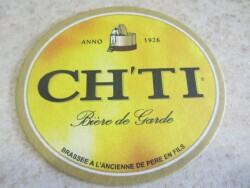
The recent movie, « Bienvenu chez les Ch’tis »–the hilarious story of a reluctant Provençal who is horrified to be transferred from his

Parlez-vous Ch’ti?

beloved, warm Provence to Lille, the “north pole”, only to be won over by the friendly, loveable townspeople—was a smash hit in France and produced an immediate spike in tourism in the area. And with good reason. The food is excellent, the accommodations first rate, the natives hospitable, the architecture breathtaking, the ambience exuberant, the size comfortable, the cultural activities multiple. A local dictum says, “What the Lillois lacks in sunshine is made up by the warmth in his heart.” What’s not to love?

Next installments on Lille: Lille, Cultural Mecca of the North; Lille, gateway to Europe; Lille, an architectural Jewel.

If you’re considering visiting this beautiful city, read more here!

Filed Under: French towns & villages, Towns & villages

« Previous Page
Next Page »

Copyright © 2026 · Dynamik-Gen on Genesis Framework · WordPress · Log in