The French Traveler

Guided Tours of France - Immersion Tours

  • Home
  • Paris Tours
    • Best of Paris tour
    • Best of Paris Registration
    • Holiday Magic in Paris
    • Holiday Magic in Paris Registration
  • Teachers: Eté 2026
    • Bonjour Chers Collegues
    • Eté 2026: Nantes Tour Schedule
    • Immersion Workshop Cost & Details Nantes 2026
    • Video: Immersion Tours for Teachers of French
    • Teacher Immersion Registration
  • Wine Tours
    • Sip and Savoir: A Wine Trip to Burgundy
    • Sip and Savoir Registration
  • About
  • Contact
  • Fbook

New Year’s Eve Traditions in France

December 29, 2011 by Valerie Sutter, Director, The French Traveler 13 Comments

New Year’s Traditions in France

Celebrating the New Year is a little different in France than in the US.

Cards. French people don’t send Christmas cards; they send New Year’s greeting cards instead. So if you are sending cards to folks in France, you don’t have to rush. People in France continue to wish each other la bonne année throughout the month of January! No interaction is complete in France in the month of January without prefacing it with Meilleurs voeux (Best wishes)

Etrennes.It is a common practice in France to give gifts of money to people who serve you on a regular basis: the mail carrier, the concierge of your apartment building, your local firemen, even the garbage man (les éboueurs). It’s the equivalent of their 13th month, and the French tend to be quite generous.

Le Réveillon. Christmas Eve dinner is known as le réveillon … and so is New Year’s Eve dinner! To distinguish the two, the celebration on the 31st is called la Saint- Sylvestre, or le réveillon de la Saint-Sylvestre, simply because the last day of the year happens to be that saint’s feast day. The festive meal is similar to the one shared on Christmas – goose or turkey, oysters, foie gras – with the addition of champagne, bien sûr, and dancing and partying long into the night; it’s at least 4 hours longer, usually longer. Metros and public transportation in the large cities are free for the evening to discourage drivers from taking to the road in their cars after imbibing.

Midnight.At the stroke of midnight on New Year’s Eve, expect to receive kisses on both cheeks and a hearty bonne année! Fireworks have been surpressed in the past years, however, due to the dangers, so the evening tends to be a private one amongst friends.

Le Jour de l’AnOn New Year’s Day – le jour de l’an – parades fill the streets which you can watch in person, if you don’t mind the cold, or on TV from the comfort of your living room!

Bonne année à tous et à toutes!


Filed Under: French customs & culture, seasons

Christmas markets in France

December 23, 2011 by Valerie Sutter, Director, The French Traveler Leave a Comment

Christmas is a very special time of year for Francophones around the world. Les marchés de Noël date back to the

Marche Colmar (Alsace)

fourteenth century in Germany, also in what is now known as the German-speaking region of France. The market was first called Le Marché de la Saint Nicolas. As far back as 1434, documentation regarding the Christmas market has been found from King Friedrich II de Saxe. One of the very first of its kind was a “Striezelmarkt” which was named after a dried fruit cake that was sold during this era. Later, during the sixteenth century, a reformation of these markets brought about a change in the market name to “Christkindlmarkt”, or “The Infant Jesus Market”, bringing even more religious reverence to the market’s meaning. These aptly named markets developed in eastern France, particularly in Strasbourg (in Alsace) in 1570.

Given the profound history of these markets, they have become well-known as places to find artisanal treasures, fine food, and festive celebrations. Christmas markets abound throughout France, found in most cities large and small, often on a main street of town or on a central city square. These markets are typically organized by a commune, and they may open as early as the middle of November, running all the way through the beginning of January. In a typical market, visitors may find vendors, Father Christmas, activities for the children and often an evening light show, an illumination of the town or city that takes place around nightfall.

Vin chaud

A typical staple of any good marché is a vin chaud, that hot mulled wine concoction flavored with a bit of orange, cinnamon, star anise and occasionally a bit of ginger. Served in tents or market stands, in shops and restaurants and even street corners throughout France, it is as much a part of the holidays as Père Noël. One can also find those delicious honey-and-spice cakes known by their Alsacian name of lebkuchen, often dipped in chocolate or powdered sugar, another tradition from the northeastern part of France.

Christmas markets are steeped in rich, historical traditions and unusual gift items, giving the visitor a perfect reason to make a December trip to France.

Filed Under: French customs & culture

Give the gift of a French Christmas!

December 16, 2011 by Valerie Sutter, Director, The French Traveler 3 Comments

With a week left to go before Christmas, for those of you who are still scratching your heads for ideas for gifts, here are a few suggestions to give a French touch to your Noël.

  1. French music: how about the First Lady’s new album? Carla Bruni’s “Comme si de rien n’était” is soft and easy listening, or for a different style, try pop singer ZAZ, (album of the same name) whose sassy original sound has taken France by storm. Both available on Amazon.
  2. The best French umbrella made in Cherbourg: Available in different colors and styles, designed to totally protect from wind and rain, made in the Normandy seacoast town that starred in the 1964 film Les Parapluies de Cherboug. www.parapluiedecherbourg.com.
  3. Escape to France vicariously every month with the stunning France Calendar 2012. 14 glossy photos of different towns and cities across the country. Days and months in both languages; French school and public holidays noted; forward planner for 2013. www.gbmags.com/calendar.
  4. A subscription to France Magazine (www.francemag.com) or France Today (www.francetoday.com) to keep up with French life and style every month; available in both online and in print format.
  5. Signature French cocktails: try a French martini made with the incomparable black raspberry liqueur crafted at the Château de la Sistière in the Loire Valley. Mix 15 ml of Chambord, 50 ml vodka, 60 ml fresh pineapple juice. C’est merveilleux! www.chambordonline.com
  6. Or try Armagnac, the oldest brandy distilled in France. Originating in the 15th century, this unique eau de vie is produced through a single distillation of white wine and then left to age in oak barrels. www.armagnac.fr. Mix a Christmas cocktail: 50 ml Blanche d’Armagnac, 1 kiwi, liquidized; 1 TBL spoon honey; 2 spring mint (including stems). Pour over crushed ice, garnished with slice of kiwi. Mmm, c’est si bon!
  7. You can’t go wrong with a film starring one of France’s most popular actresses, Audrey Tatou: Venus Beauty Institute (1999); Amélie (2001); Dirty Pretty Things (2002); Priceless (2006); Coco Before Chanel (2009; Beautiful Lies (2011). www.amazon.com.
  8. Gift a week’s vacation in the south of France! Reserve time at a private furnished townhouse with sweeping views of the Gorges du Loup near the French Riviera or an apartment in the quintessential Provençal town of Aix-en-Provence. www.greatfrenchrentals.com
  9. Alphabet chocolates from St-Rémy-de-Provence. Specialty chocolatier Joël Durand sends you the flavors of Provence—almond, lemon, orange, thyme, rosemary, chestnuts, honey, violets, even olvies—crafted into each letter of the alphabet and six punctuation marks. www.chocolat-durand.com.
  10. Any of the delightful gifts available from the boutique of the newly renovated Orsay Museum. www.boutiquesdemusees.fr


Filed Under: French customs & culture

Paris for the winter holidays

December 2, 2011 by Valerie Sutter, Director, The French Traveler Leave a Comment

Paris for the holidays

What’s going on in Paris this holiday season? Consider visiting Paris during the winter and you’ll avoid the heat and the summer crowds. This year there are many art exhibits to choose from, as well as music, good food, and of course, lights, always lights!

Exhibits:

  • Babar, the beloved elephant king celebrates his 80th birthday with an exhibit at the Musée des arts décoratifs, beginning December 8th entitled “Les histoires de Babar”. Children are free.
  • Also for the young and young at heart is “Sempé: A bit of Paris,” at the Hôtel de Ville (until Feb. 11). At this exhibit you’ll see over 300 drawings as well as original texts by the famous French cartoonist. Free admittance.
  • The “Cézanne and Paris” exhibit will be at the Luxembourg museum through February 26th. Although he is usually associated with Provence, Cezanne’s artistic development owes a lot to the capital.

Food:

  • Whether it’s at a cozy bistro, or a four-star restaurant, make sure to have something traditional for the season: raw oysters, for example, as an appetizer, followed by game bird stuffed with chestnuts. And for dessert, of course, a creamy bûche de noël.

Lights:

  • Paris isn’t nicknamed the City of Lights for nothing. The capital will dazzle you especially during the holiday season. You will find lights throughout the city, but make a point to see the Champs-Elysées, the Place Vendôme, and Avenue Montaigne.

Music:

  • If you get a little homesick while you’re in Paris (is it possible?), attend a production of Rodgers and Hammerstein’s American musical, The Sound of Music, at the Théâtre du Châtelet, from December 7 – January 1st.


Bonnes fêtes à tous !

Filed Under: seasons

Away from the crowds in Paris!

November 27, 2011 by Valerie Sutter, Director, The French Traveler Leave a Comment

Away from the Crowds, part II

Continuing our jaunts outside the City of Lights, here are a few more notable excursions easily made under an hour from Paris:

  • VAUX-LE-VICOMTE: A miniature Versailles, in fact, exactly that: full of intrigue and a murky past. Nicolas Fouquet purchased a small chateau of no consequence outside Paris 1641 and commissioned architect Louis Le Vau and landscaper Le Nôtre to enlarge and beautify it. Upon completion of the work in 1661, Fouquet, then First Minister under Louis XIV, offered the king a tribute to his kingdom by throwing an enormous party, ending the resplendent evening with a spectacular display of fireworks, which particularly impressed the queen.

  • Little did Fouquet know that would be his last public appearance. Furiously jealous of this remarkable home and convinced that Fouquet had been raiding the kingdom’s treasury to build it, Louis had Fouquet thrown into jail the following day and imprisoned for the rest of his life, then promptly hired Le Vau and Le Nôtre to remake his hunting lodge at Versailles. Fouquet died in 1680 without ever seeing his castle again. Moonraker, Valmont, D’Artagnan’s Daughter, The Man in the Iron Mask were filmed here. One can also privatize the chateau for a party or wedding; in 2007, Tony Parker and Eva Longoria did just that. Trains from Gare de Lyon to Melun; then, a Chateaubus shuttle. Or RER D to Melun, then Chateaubus.

  • FONTAINBLEAU: By turns hunting lodge, country home of kings, and residence of the king’s mistress, this magnificent chateau only 35 minutes south of Paris has retained its elegance and charm despite demolitions, reconstructions, additions, and embellishments of all sorts. It was here in 1685 that Louis XIV signed the disastrous Revocation of the Edict of Nantes, as well as the secret treaty between France and Spain in 1785 concerning the Louisiana territory in North America. The castle is surrounded by a magnificent national forest, a favorite of hikers and equestrians. Trains from Paris Gare de Lyon to Fontainebleau-Avon.
  • GIVERNY: For a day of artistic beauty and country authenticity, travel to the small town of Giverny, 80 kms NW of Paris, home to Impressionist Claude Monet for 43 years. You can visit Monet’s home and gardens, his well-known Japanese bridge, the museum shop and small café. Don’t overlook the Musée des Impressionismes next door, open April 1-Oct 31. Trains from the Gare St-Lazare to Vernon; from Vernon, either walk the 6 kms, take a taxi, or the shuttle bus which runs between April and October.


Filed Under: French towns & villages, Towns & villages

The majestic Eiffel Tower

November 26, 2011 by Valerie Sutter, Director, The French Traveler Leave a Comment

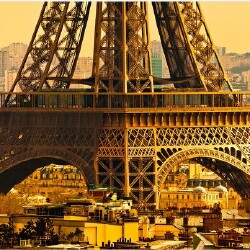
Group tours to Paris inevitably include a must-see visit to the Eiffel Tower, synonymous with the city of Paris. It is the most visited eiffel towerlandmark in the world with nearly 7,000,000 people from every corner of the globe each year. Designed by Gustave Eiffel, who won the bid out of 107 bidders, and built in 1889 for the Universal Exposition to commemorate the centenary of the French Revolution, the iron-clad structure attests to its roots in infrastructure technology during the 19th century. It stands a whopping 324 meters high (1063 feet), with three levels, at a total weight of 22,000,000 pounds (10,100 tons).

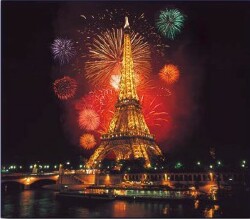
A 360 degree, panoramic view of Paris is seen from the Eiffel Tower. The tower is illuminated in the evenings, and it sparkles with breathtaking vibrancy for 10 minutes every hour on the hour until 1:00 am each evening.

Each of the three levels offers a slightly different perspective overlooking Paris, each with a different admission price. The first level is 190 feet above the ground, the second- 380 feet, and the third- 900 feet. The first level is open and currently undergoing renovation, while boasting boutiques, restaurants, and even a cinema showcasing the history of the Eiffel tower. For visitors with children aged 6-10, a kid-friendly host named Gus helps these little tourists to learn about the Tower’s history. The second level offers 3 souvenir shops, and places to eat, including the well-known, modern and chic, “Jules Verne” restaurant. Reservations highly recommended. The third level shows a wax-figure reconstruction of Eiffel’s office. At the summit there is also a champagne bar, and interesting facts about La Tour Eiffel, such as how much paint is used every seven years to repaint the tower (60 tons).

The best views from the tower can be seen after dark, when the City of Lights shows its finery. Views of the city are often clearer and better defined without the haze of the daylight, and the lines of people waiting to go up are less long. Overlooking the Iena Bridge on one side and the beautiful Champs de Mars on the other, the Tower is the background setting to the most beautiful display of fireworks

Fireworks near the Eiffel Tower

Fireworks near the Eiffel Tower

display every national holiday, the 14th of July. A stroll along the Seine River invariably keeps the Tower in view. One of the nicest images of it is from the Mirabeau Bridge, where once can capture both the Tower and the miniature Statue of Liberty, which is posted on the Grenelle Bridge.

The Eiffel Tower is an incredible feat of architecture. Initially expected to last a mere 20 years, it has stood for more than 120 years, and has become the symbol of France/ Hours: every day from 9am to 11pm, and until 12 midnight during the summer. Metro stops: Bir-Hakeim, or Alma; Trocadero; RER-C Champs de Mars. Take a virtual tour HERE.


Filed Under: French customs & culture

« Previous Page
Next Page »

Copyright © 2026 · Dynamik-Gen on Genesis Framework · WordPress · Log in