The French Traveler

Guided Tours of France - Immersion Tours

  • Home
  • Paris Tours
    • Best of Paris tour
    • Best of Paris Registration
    • Holiday Magic in Paris
    • Holiday Magic in Paris Registration
  • Teachers: Eté 2026
    • Bonjour Chers Collegues
    • Eté 2026: Nantes Tour Schedule
    • Immersion Workshop Cost & Details Nantes 2026
    • Video: Immersion Tours for Teachers of French
    • Teacher Immersion Registration
  • Wine Tours
    • Sip and Savoir: A Wine Trip to Burgundy
    • Sip and Savoir Registration
  • About
  • Contact
  • Fbook

Joan of Arc: 600 years of French history

May 27, 2012 by Valerie Sutter, Director, The French Traveler 3 Comments

Joan of Arc

This year France is celebrating the 600th anniversary of Jeanne d’Arc, known as the Pucelle d’Orléans, or the Maid of Orléans. So where can one learn more about this iconic French figure?

  • Visit her native village, Domrémy-la-Pucelle in the region of Lorraine in Eastern France. There, you can roam through the family home where she was born in 1412 and visit the church where she was baptized. The museum in Domrémy is dedicated to her life and times.
  • In the city of Orléans, where as a young girl she famously repelled English invaders during the Hundred Years War, visit the Centre Jeanne d’Arc which houses a huge collection of documents relating to her.
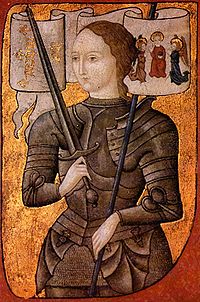
  • Joan of ArcIn the city of Rouen in Normandy, Joan of Arc was condemned for heresy and burned at the stake by the English occupiers of that city, in 1431. Here you can visit several sites commemorating the heroine: the Pucelle’s Tower where she was imprisoned before her trial, the Boideldieu Bridge where her ashes were scattered into the Seine, and the flower garden at the Place du Vieux-Marché which now marks the place where she died.
  • For armchair travelers curious about the French heroine, sources abound. Just published this year is the 1,000-pageJeanne d’Arc, Histoire et Dictionnaire, as well as a fictionalized biography by well-known French author Max Gallo. Numerous biographies have been published in English as well as French, including those by Régine Pernoud, Andrew Lang and even Mark Twain.
  • Joan of Arc has been the subject of many films, as well, including the 2005 documentary entitled Joan of Arc: Child of War Soldier of God, the 1948 movie about Joan of Arc starring Ingrid Bergman, and the classic silent film made in 1928 by Carl Dreyer: La Passion de Jeanne d’Arc.
Filed Under: French customs & culture

The national holidays in May in France

May 13, 2012 by Valerie Sutter, Director, The French Traveler Leave a Comment

The month of May is always an exciting time in France with the beginning of warmer weather, Labor Day celebrations, la Fête du Muguet and a host of other holidays.

  • May is when temperatures really start to warm up in France. “Avril, ne te découvre pas d’un fil; mai, fais ce qu’il te plaît!” is French for: “April showers bring May flowers.” (Literally: In April, better keep your warm clothes on; in May, do as you like!)
  • May 1st is a national holiday, the French equivalent of Labor Day, or la Fête du Travail. Most everything is closed except for restaurants, churches, and some museums and monuments such as the Eiffel Tower. Limited public transportation may be running; however, you just might have trouble reaching your destination due to street demonstrations. Better take to the streets yourself and join the celebrations for workers’ rights (or whatever cause you may fancy!)
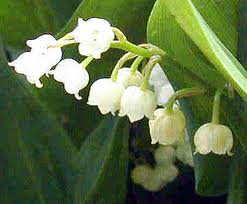
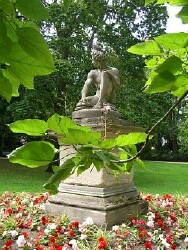
  • May 1st is also known as la Fête du Muguet, or Lily of the Valley Day. Mais pourquoi? Well, according to legend, King Charles IX received a bunch of these sweet-smellingwarm weather and national holidays flowers on May 1st, 1561, as a good luck charm. Ever since, it is traditional for family, friends and neighbors to exchange a small sprig as a goodwill gesture. You may find lily-of-the valley growing naturally in woods and gardens in France, but don’t worry: vendors will be selling bunches of the flower on every street corner.Other May holidays include: May 8th, la Fete de la Victoire which commemorates the end of World War II, the Catholic holidays of Ascension and Pentecost, and finally, Mother’s Day, which always falls on the last Sunday of the month.
  • If you’re in France during this month, you’ll get to learn the idiomatic expression “faire le pont” (literally, “make the bridge”) which refers to the time taken off on days surrounding a national holiday, exemplifying the French passion for extra leisure time. For example, this year’s May 1 Fete du Travail falls on a Tuesday. Many businesses will close on Monday April 30 to “faire le pont” until Wednesday and make an extra long weekend of it. Ditto for Thursday, May 17, the Ascension: many businesses will close on Friday, May 18 for another long weekend. Sometimes, there are so many “ponts” during the month of May that it’s really more like “faire le viaduc!”


Filed Under: French customs & culture, seasons

Summer in Paris: Events

May 13, 2012 by Valerie Sutter, Director, The French Traveler Leave a Comment

Art, history, music, science, nature, haute couture….. Whether you are planning a trip to Paris this summer or just passing through the capital, be sure to check out these very original exhibits!

summer in paris exhibit

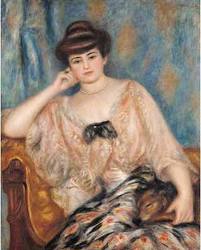
  • If you are interested in French artistic life from the Belle Epoque to the Twenties, come see portraits of one of the most painted women of her time: Misia Godebska, at Musée d’Orsay’s exhibit: “Misia, Queen of Paris,” from June 12th through September 9th.
  • The Galérie des Gobelins is presenting “La Tenture de Moïse” (The Moses Tapestry), based on works by Nicolas Poussin. This is the first time the Tapestry will be shown in its entirety since it was first created in the 17th century. The exhibit will run from May 22nd to December 1st.
  • History buffs should see the exhibit about the Gauls at the Cité des Sciences et de l’Industrie where they will learn about the daily life, agriculture, and the social organization of these French ancestors. Through September 2nd.
  • Visitors of all ages will love “Les Histoires de Babar” (The Stories of Babar) which celebrates the famous French elephant’s 80th birthday with this exhibit running through September 2nd at the Musée des Arts Décoratifs.
  • “Rodin, la chair, le marbre” (Rodin, Flesh and Marble) will open June 8th
  • Rodins gardenAnd if you’re an animal lover you won’t want to miss, “Beauté Animale” (Animal Beauty) at the Grand Palais which presents 130 paintings, drawings, sculptures, engravings and photographs of animals, from the Renaissance to the present in works by Courbet, Durer, Degas, Gericault, and others. Ends July 16th, so you have to hurry!
Filed Under: seasons

France in May: events

May 6, 2012 by Valerie Sutter, Director, The French Traveler Leave a Comment

Visiting France in May

If you are lucky enough to be in France this month, you won’t want to miss these wonderful events.

  • May 19th is Museum night (la Nuit des Musées) when museums all over France are open free of charge until late into the night. Created in France in 2005 by the French Ministry of Culture, it is now also called European Museum Night and is celebrated in 40 European countries.
  • On May 22nd the French Open International Tennis tournament begins in Paris at the Roland Garros stadium. Fans will get a thrill out of watching their favorite tennis champs compete on the stadiums’ famous red clay courts. Through June 10th.

Cannes Croisette sights in France in May

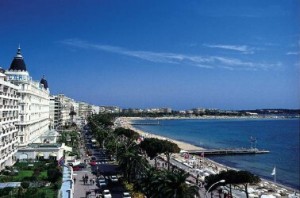
  • The Cannes Film Festival takes place this year from May 16th through 27th. Although this international film festival is by invitation only, you can still take part in the excitement if you’re in town and maybe even get a glimpse of the stars! Visitors can get tickets for the Cinéma de la Plage, a public event which occurs outdoors on a giant screen where cinéphiles will be able to watch movies to their heart’s content. Contact the Cannes Tourist Office for more information.
  • If children accompany you to Paris in May, they might just ask, like French kids do, to go to the huge Fair called the Foire du Trône located at the Pelouse de Reuilly in the Bois de Vincennes (Métro : Porte Dorée, Liberté, or Porte de Charenton). This annual event is a traditional carnival fair complete with roller coasters, ferris wheels and barbes à papa (cotton candy). Very popular with French families. Runs through June 3rd.
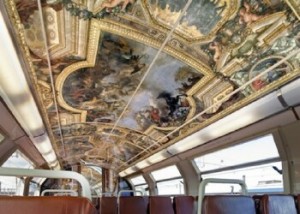
  • A newly outfitted RER-C train to Versailles has just been inaugurated with magnificent photo panels of the palace glued to the train’s ceilings and walls. There will be five of these trains by the end of the year outfitted with such panels. If you’re lucky enough to catch one of them on the way to Versailles, it will be the closest you’ll come to that masterful ceiling painted so breautifully in the 17th century by Charles le Brun.


Filed Under: French customs & culture, seasons

Arcachon and the forest of the Landes

March 25, 2012 by Valerie Sutter, Director, The French Traveler Leave a Comment

Arcachon and the Landes

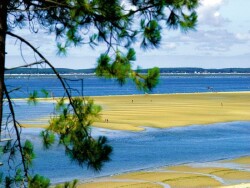
arcachonOn the Atlantic coast not far from Bordeaux lies the beautiful seaside town of Arcachon, well-known for its oyster culture, its fishing harbor, and its bathing resort where sea winds mix with the fresh scent of pine trees from the nearby forest of the Landes.
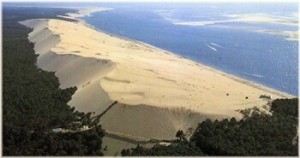
Situated at the base of the Arcachon basin, and originally a vast desert, the city of Arcachon was the brainchild of the barons of power in the 19th century who saw a unique opportunity to create an elite spa-town in this wild and beautiful area. François Legallais decided to create the first hotel in 1823, extolling the virtues of the sea air and the forest pines. His gamble paid off: the city quickly built its reputation as a place to cure tuberculosis and lymphatic disease, becoming a four-star destination for the wealthy Bordeaux residents who created enormous mansions as their second homes in what became known as the “Ville d’hiver”, the winter town. Other areas soon built up, giving the names of the four seasons to the different areas, hence one can also find the summer town, the spring town and the autumn town.

Known for its wild dunes, the nearly 15,000 square kilometers of the area are covered with a thick sand, which, carried by winds, create dunes of varying heights. The inland dunes do not usually exceed 15 meters high and are fixed from moving too much by vegetation.

The coastal dunes, however, are still “active,” and can reach much greater heights due to their constant movement. The Dune du Pyla (or Pilat), near Arcachon, is Europe’s largest sand dune at over 100 meters high. It’s quite a feat to climb it, but the view from the top of the Atlantic Ocean and the city itself is breathtaking.

French teachers, join us this summer as we travel to Arcachon from Bordeaux for a lively day’s outing during our workshop for French teachers to be held July 15-26, 2012. Click here for further details.


Filed Under: French towns & villages, Towns & villages

Bordeaux Architecture and Renovations

March 18, 2012 by Valerie Sutter, Director, The French Traveler Leave a Comment

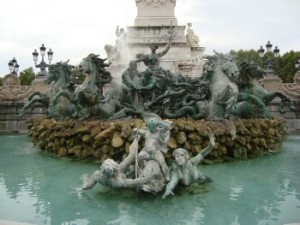
Fontaine Quinconces Bordeaux Architecture

Alain Juppé, former prime minister of France and long-time mayor of Bordeaux, initiated massive renovations of the city in the 1990’s, bringing the formerly dark and closed city into the 21st century. An efficient and wide-reaching tramway spread over the city, huge restructuring of the quays along the Garonne River, an opening of the Vieille Ville and the cleaning up of many of the medieval buildings have totally transformed Bordeaux into a modern, elegant and bright city. Take a short tour of the new city and enjoy the beautiful Bordeaux architecture.

Start at the Place Quinconces, the largest public square in France. Formerly the home of a medieval fortress demolished in 1820, the Quinconques Square today boasts a 43-metre monument to the victims of the Terror who were guillotined during the French Revolution. Adorned with several dramatic statues of horses representing the Garonne River, the Dordogne River, and the city of Bordeaux, the motto “Liberty Breaking Free from her Chains” expresses the spirit of this proud city today.

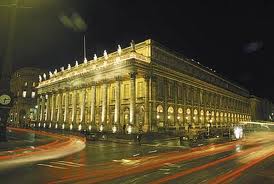
From the Quinconces Square, make your way to the Grand Theatre, currently the Bordeaux Opera House, surrounded by arcades and a portico with giant columns, it hosts a lively restaurant and is general meeting place for the Bordelais residents.

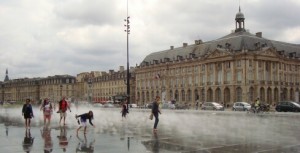
fog on place bourse Bordeaux

Take Tram B a few stops along the Quai des Chartrons to witness the incredible upheaval in this former portuary area, all cleaned up. Several new shops, restaurants, covered markets and chic boutiques nest in the old warehouses where wine barrels once stood. Always the busy center of town as the main center of the wine trade, the Chartrons boardwalk, a few kilometers long, has been remade as a public garden and follows the banks of Garonne and ends up a the Public Gardens, passing in front of the beautiful buildings of the Bourse and the remarkable “mirror of water”.

Innovative design can be found throughout Bordeaux today, expressing its renewal and dynamism while remaining true to its former glory as the center of the French wine trade.

If you plan on visiting, take this Bordeaux Architecture walking tour and enjoy the sites!

Filed Under: French towns & villages, Towns & villages

Bordeaux History Lessons

March 11, 2012 by Valerie Sutter, Director, The French Traveler Leave a Comment

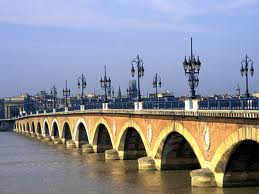
Pont St Pierre- Bordeaux HistoryPart of the enchantment of the city of Bordeaux is its fascinating history. In addition to its excellent location on the Garonne River at the mouth of the Gironde estuary, its turbulent but compelling past may be summed up in three stages:
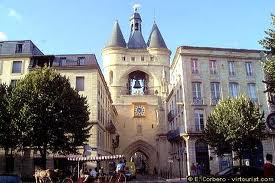
  • Known as Burdigala in Roman times, the city owed its fortune to the creation of the first vineyard along the Atlantic coast during the first century. This gallo-roman city called “little Rome” cultivated an Antique civilization which lasted until the invasion of the Francs and the Normans, beginning in the third century, when the city fell into a period of obscurity.

Porte Caillhau

  • During the Middle Ages, the long-lasting political union between the duchy of Aquitaine and the British Royalty (1154-1443) brought about great prosperity due to the export of Bordeaux wines to the British Iles. By the 14th century the city’s population had grown to nearly thirty thousand, very high for a medieval town.
  • The third period of Bordeaux’s prosperity came during the 18th century, again due to its thriving wine culture, especially in the Médoc region. By this time Bordeaux had become annexed to France and was an important port for colonial commerce, trading sugar, coffee and slaves from the West Indies. With its aristocratic parliament and its intellectual elite (including Montesquieu), the 18th century is known as Bordeaux’s “golden age.” French author Victor Hugo found the town so beautiful he once claimed, “Take Versailles, add Antwerp, and you have Bordeaux”. In 1856, Baron Haussmann, a long-time prefect of Bordeaux, used Bordeaux’s 18th century big-scale rebuilding as a model when asked by Emperor Napoleon III to modernize a then still medieval Paris. Visitors can see evidence of Bordeaux’s classical architecture in such splendeurs as the Place Royale, the buildings along the quays, and the Grand-Theatre.

Take a guided tour and see how Bordeaux’s glorious past is reflected in the modern city of today. Bonne visite!

Filed Under: French towns & villages, Towns & villages

French wine: Sauternes, Bordeaux

March 4, 2012 by Valerie Sutter, Director, The French Traveler Leave a Comment

Bordeaux – Sauternes

If you have a sweet tooth when it comes to wine, you won’t want to miss the wine region known as Sauternes, located along the left bank of the Garonne river, about twenty miles southeast of Bordeaux. Sauternes are known for their velvety, honey-like sweetness, and they just happen to go well with another French delicacy: fois gras.

Why are Sauternes so sweet? Two reasons: late harvesting and something the French call pourriture noble, or….”noble mold”! For these wines, the grapes must stay on the vine until very late in the season. The autumn sun begins to dehydrate them until a mold called Botrytis cinerea takes over, turning the grapes nearly into raisins. The resulting “grape juice” is very high in sugar and low in water content which produces the thick, viscous quality so characteristic of Sauternes.

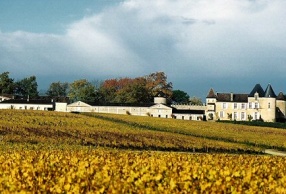
SauternesThe best known vineyard in Sauterne region is the beautiful Chateau d’Yquem which once belonged to Eleanor, Duchess of Aquitaine. After she and King Louis VII of France divorced and she married Henry Plantagenet, the future King Henry II of England in 1154, the chateau came under British dominion until the end of the Hundred Years War in 1453, a most royal and British estate. Back under French control in 1593, the chateau has been improved and modified several times under the watchful eye of the Sauvage and Lur-Saluces families, and has produced award-winning wines over the centuries. Thomas Jefferson bought several cases in 1784, proclaiming it the best wine of Bordeaux. Today partially owned by the luxury marketing group LVMH, it possesses approximately 226 acres of vineyards, although not all are in production at any one time, allowing for elimination of elderly vines and replanting in fallow plots. The mix of the grapes is 80% Semillon and 20% Sauvignon Blanc, with none of the permitted Muscadelle. The grapes are harvested by hand in several different batches and fermented in oak, usually about three years per barrel.
Similar-tasting wines from this region which are a little less expensive can be found in the neighboring townships of Fargues, Preignac, Bommes, and Barsac.

Bonne dégustation!

Filed Under: French towns & villages, Wine

French Wine: Cabernet Sauvignon

February 26, 2012 by Valerie Sutter, Director, The French Traveler Leave a Comment

Red wine, anyone?

The Cabernet Sauvignon grape is practically synonymous with red wine, and where else to taste the best of the best, but in the Médoc and the Haut Médoc wine regions of Bordeaux, France.

Just near enough to the Gironde river, conditions here are perfect for what is known as one of the world’s finest wine grapes. Although the wine made from the Cabernet Sauvignon grape is astringent when young due to the tannin it contains, Cabernet wines mellow with age into that delicious, full-bodied taste we all know and love.

cabernet sauvignon

Some of the wines made at the famous Château Mouton-Rothschild in the Médoc use a very high percentage of Cabernet grapes – up to ninety percent! Located just outside the village of Pauillac, thirty miles to the north-west of Bordeaux, Mouton-Rothschild is a magnet for the red wine lover. No other vineyard in the Médoc uses more Cabernet Sauvignon than Mouton-Rothschild.

Besides tasting their delicious wine, visitors to the Château Mouton-Rothschild should not miss the wine museum with its collection of “all things wine,” going back to Roman times…

Thirsty yet?

Filed Under: French towns & villages, Wine

Bordeaux Wines

February 19, 2012 by Valerie Sutter, Director, The French Traveler Leave a Comment

Médoc, Graves, Entre-Deux-Mers, Pomerol, Sauternes, Saint-Emilion…. What do these poetic-sounding names have in common? You are right of course if you answered Bordeaux Wines! Bordeaux is the greatest wine-producing region of the world!

Bordeaux Wines

Located in the Aquitaine region of south-western France, Bordeaux is one of France’s largest cities with a population well over 200,000. It lies thirteen miles up the coast where the Garonne and Dordogne rivers meet, and Bordeaux’s great harbor bustles with maritime traffic from all over the world. It comes as no surprise that the name “Bordeaux” literally means: “beside the waters” (au bord des eaux).

This is one region of France that oenophiles (wine-lovers) will not want to miss, for Bordeaux wines offer something for everyone’s taste: from light, sophisticated red wines to robust, full-bodied ones, from dry white wines to luscious sweet whites, even sparkling rosés and whites produced à la méthode champenoise.

Visiting the famous vineyards of Bordeaux is a must for the thirsty traveler and makes for easy day excursions as they lie all around the city: Pomerol and Saint-Emilion to the east, Entre-Deux Mers to the southeast, Sauternes to the south, Graves to the southwest and west, and the Médoc and the Haut-Médoc to the northwest.

A votre santé!


Filed Under: French towns & villages, Wine

« Previous Page
Next Page »

Copyright © 2026 · Dynamik-Gen on Genesis Framework · WordPress · Log in